
Last Updated on March 11, 2026 by Luxor Content Team
When you book a chauffeur service, you’re not just paying for a driver. You’re paying for a safe, comfortable, and reliable journey from start to finish. And a big part of what makes that possible is the vehicle itself.
Modern luxury chauffeur vehicles are built with far more safety technology than the average car on the road. From advanced driver assistance systems to interior passenger protections, today’s professional fleet vehicles are designed to keep everyone on board safe — whether you’re heading to the airport, a corporate meeting, or a wedding.
This article breaks down the safety features you’ll find in modern chauffeur vehicles and explains why they matter for anyone who travels with a professional chauffeur service.
Why Vehicle Safety Matters in Chauffeur Services
Safety in passenger transport isn’t just a checkbox. It’s the foundation of a trustworthy service.
A professional chauffeur is responsible for the wellbeing of every person in that vehicle. That responsibility extends beyond careful driving — it includes the vehicle’s condition, its technology, and how well that technology works in real-world situations.
For chauffeur services operating in busy cities like Melbourne, safety becomes even more critical. Heavy traffic, variable road conditions, and tight schedules all create situations where a vehicle’s safety systems can make a real difference.
When clients choose a luxury chauffeur service over a standard rideshare, they’re often making that choice based on trust. Trust that the driver is professional. Trust that the vehicle is well-maintained. And trust that if something unexpected happens on the road, the right systems are in place to protect them.
That’s why reputable professional chauffeur services prioritise passenger safety at every level — from driver training and licensing to the vehicles they put on the road.
The Role of Safety in Luxury Passenger Transport
Luxury transport has always been about more than comfort. It’s about confidence.
When a client steps into a high-end chauffeur vehicle, they should feel secure — not just physically, but in the knowledge that every detail has been considered. The vehicle should be clean, well-serviced, and equipped with the latest technology. The driver should be calm, experienced, and focused.
That combination of human professionalism and vehicle technology is what separates a genuine luxury chauffeur fleet from a basic car service.
Modern luxury vehicles — Mercedes-Benz, BMW, and similar brands commonly used in professional fleets — now come standard with an impressive range of safety systems. These aren’t optional extras. They’re built-in protections that work quietly in the background, helping the driver respond faster and more effectively to hazards on the road.
Advanced Driver Assistance Systems (ADAS)
Advanced Driver Assistance Systems, or ADAS, is a broad term for the collection of electronic safety technologies built into modern vehicles. These systems use sensors, cameras, radar, and software to monitor the vehicle’s environment and support the driver in real time.
ADAS doesn’t replace the driver — it supports them. Think of it as a second set of eyes that never gets tired, distracted, or caught off guard.
For chauffeur fleets, ADAS-equipped vehicles offer a significant safety advantage. They reduce the likelihood of human error — which, according to road safety research, is a contributing factor in the vast majority of road accidents. When a driver is navigating Melbourne’s CBD or an unfamiliar suburb, having these systems working in the background adds an important layer of protection.
Some of the key ADAS features found in professional chauffeur vehicles include the following.
Collision Prevention and Automatic Emergency Braking
How Collision Prevention Works
Collision prevention systems use sensors and cameras to detect objects or vehicles ahead and calculate the risk of impact. If the system determines that a collision is likely, it alerts the driver — and if the driver doesn’t respond quickly enough, it takes action automatically.
Automatic Emergency Braking (AEB)
Automatic Emergency Braking is one of the most important active safety features in any modern vehicle. When sensors detect that a collision is imminent, the system applies the brakes without waiting for driver input. This can significantly reduce impact speed — or prevent the collision entirely.
AEB systems in today’s luxury vehicles are sophisticated enough to detect not just other vehicles, but also pedestrians and cyclists. In a city like Melbourne, where foot traffic and cycling are common in inner suburbs, this matters a great deal.
For passengers in a chauffeur vehicle, AEB means that even in a moment of unexpected hazard, the car is already responding — often faster than any human could.
Lane Keeping Assist and Lane Departure Warning
Lane Departure Warning
This system uses a forward-facing camera to monitor lane markings. If the vehicle begins to drift out of its lane without a turn signal being activated, the driver receives a visual or auditory alert.
It’s a simple concept, but it’s particularly useful on long highway drives — like a Melbourne airport transfer on the freeway — where driver fatigue or brief distraction can cause unintentional lane drift.
Lane Keeping Assist
Lane Keeping Assist goes one step further. Rather than just warning the driver, it actively applies gentle steering corrections to guide the vehicle back into the lane. This happens smoothly and doesn’t override the driver — it simply nudges the car back to where it should be.
Together, these two features help keep a chauffeur vehicle tracking safely and predictably, even in demanding driving conditions.
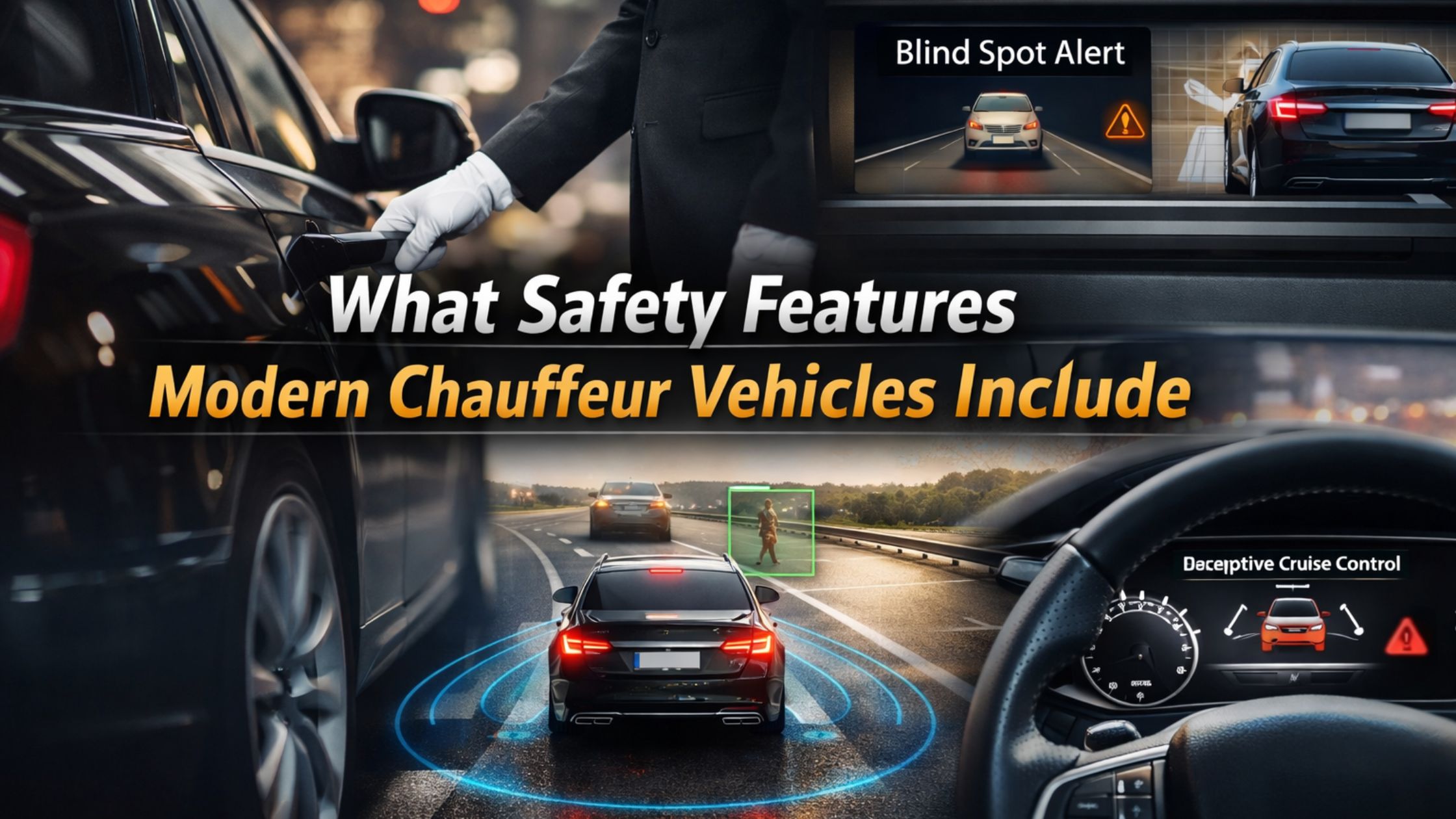
Blind Spot Monitoring
Even experienced drivers have blind spots. The areas just behind and beside the vehicle that mirrors don’t fully cover can hide motorcycles, cyclists, and smaller vehicles — especially in urban traffic.
Blind spot monitoring uses radar sensors to watch these areas continuously. When a vehicle enters a driver’s blind spot, a warning light appears on the corresponding side mirror. If the driver then activates the turn signal to move into that lane, the warning becomes more urgent — with an auditory alert added to the visual one.
For a chauffeur operating in Melbourne’s busy lane-changing traffic, blind spot monitoring reduces the risk of side-swipe incidents significantly. It’s a quiet, reliable feature that works every time without requiring any input from the driver.
Adaptive Cruise Control
Standard cruise control maintains a set speed. Adaptive cruise control does more — it maintains a set speed and a safe following distance from the vehicle ahead, automatically adjusting as traffic speeds up or slows down.
In freeway conditions, this system reduces driver fatigue and keeps the chauffeur vehicle at a safe distance without the need for constant manual throttle and brake adjustments. If traffic slows significantly, the system can bring the vehicle to a complete stop and then resume speed when traffic moves again.
For clients travelling on longer routes — say, from Melbourne CBD to Tullamarine Airport — adaptive cruise control means a smoother, more consistent ride with less abrupt braking or acceleration.
360-Degree Cameras and Parking Sensors
360-Degree Camera Systems
Modern luxury vehicles often come equipped with a 360-degree camera system — a collection of cameras positioned around the vehicle that feed a composite bird’s-eye view to the in-dash display. This gives the driver a complete picture of the vehicle’s surroundings when manoeuvring at low speeds.
For chauffeur vehicles operating in tight hotel driveways, airport drop-off zones, and underground car parks, this is genuinely useful. It makes precision parking and reversing much easier and reduces the risk of minor collisions with other vehicles, bollards, or kerbs.
Parking Sensors
Front and rear parking sensors use ultrasonic technology to detect obstacles within close range. As the driver gets closer to an object, the beeping frequency increases — giving a clear, immediate warning to stop. Combined with camera systems, parking sensors make close-quarter manoeuvring much safer and more confident.
Airbags and Passenger Protection Systems
The vehicles used by professional chauffeur services are typically equipped with a comprehensive airbag system that goes well beyond the standard front driver and passenger airbags.
Modern luxury vehicles may include:
- Front airbags for driver and front passenger
- Side curtain airbags that deploy along the entire roofline to protect all rows of passengers
- Side torso airbags in seat bolsters to protect chest and pelvis in side impacts
- Knee airbags to reduce lower limb injuries in frontal collisions
For clients seated in the rear — which is common in chauffeur transport — side curtain and rear side airbags provide meaningful protection in the event of a side or rollover impact. This is an often overlooked but important aspect of passenger safety in luxury transport.
Vehicle Stability and Traction Control
Electronic Stability Control (ESC)
Electronic Stability Control monitors the vehicle’s direction of travel and detects when the car begins to skid or deviate from the driver’s intended path. When this happens, it automatically applies brakes to individual wheels and reduces engine power to bring the vehicle back under control.
ESC has been compulsory on new vehicles in Australia since 2011, but in modern luxury vehicles, the system is more refined and responsive than ever. It works in milliseconds — far faster than any driver could react manually.
Traction Control
Traction control prevents wheel spin during acceleration, particularly on wet or slippery road surfaces. In Melbourne, where winter rains can make roads unpredictable, traction control helps a chauffeur vehicle accelerate smoothly and maintain grip without skidding.
Both of these systems work together to keep the vehicle planted and predictable, which is especially important when carrying passengers who may not be wearing seatbelts — a reminder that passenger safety also depends on passengers following basic precautions.
Tyre Pressure Monitoring Systems (TPMS)
A tyre blowout at highway speed is one of the most dangerous things that can happen on the road. Tyres that are underinflated are more susceptible to blowouts, and they also reduce handling performance and increase braking distances.
Tyre Pressure Monitoring Systems alert the driver when any tyre drops below the recommended pressure. In a professional chauffeur fleet, this is an important early warning tool — allowing the driver or fleet manager to address the issue before it becomes a hazard.
Combined with regular tyre inspections and replacement schedules, TPMS helps ensure that every chauffeur vehicle on the road is running on tyres that are safe and performing correctly.
Real-Time Navigation and Traffic Systems
Getting passengers to their destination safely and on time requires good route planning — and in Melbourne, that means staying ahead of traffic.
Modern chauffeur vehicles are equipped with real-time navigation systems that integrate live traffic data, road incident alerts, and route optimisation. If there’s an accident ahead on the freeway, the system will suggest an alternative route before the driver reaches the congestion.
For airport transfers and corporate travel, where timing is critical, this kind of intelligent navigation means fewer delays and more predictable journey times. It also keeps the driver focused on the road rather than constantly monitoring a phone.
GPS Tracking and Fleet Monitoring
GPS tracking serves two purposes in a professional chauffeur fleet. First, it gives operators visibility over where every vehicle is at any given moment — which is important for coordinating pickups, managing schedules, and responding quickly if a vehicle is delayed or diverted.
Second, GPS data can be used to monitor driving behaviour. Fleet management systems can record speed, harsh braking, rapid acceleration, and other indicators of driving style. This gives fleet managers the ability to identify and address any behaviour that falls outside expected standards.
For clients, GPS tracking also means that their journey is logged — which adds a layer of accountability and security to the service.
Interior Safety Features for Passengers
The interior of a professional chauffeur vehicle is designed with passenger comfort in mind — but comfort and safety often go hand in hand.
Key interior safety considerations include:
- Rear door child locks and secure door mechanisms that prevent accidental opening while the vehicle is in motion
- Grab handles and assist handles positioned for easy entry and exit, particularly for older passengers or those with mobility challenges
- Premium seatbelts in all seating positions, including rear seats, with clear and accessible buckles
- Non-slip floor surfaces and mats to prevent slipping when entering or exiting the vehicle
- Adequate headroom and legroom to allow passengers to sit and move comfortably without risking injury during sudden stops
In vehicles like the Mercedes-Benz Sprinter used for group transport, interior safety also includes proper seating configurations with individual seatbelt positions for every passenger and structural reinforcement throughout the cabin.
Regular Vehicle Inspections and Maintenance
Safety features only work if the vehicle is well-maintained. A sensor that’s been damaged, a brake system that’s overdue for service, or a tyre that’s worn below safe tread depth — all of these can compromise even the most sophisticated safety technology.
Reputable chauffeur fleet operators follow strict maintenance schedules that go beyond the minimum required by law. This includes:
- Regular brake inspections and fluid checks
- Scheduled tyre rotation and replacement
- Sensor and camera calibration checks
- Software updates for ADAS and onboard systems
- Full vehicle checks before and after each shift
This kind of disciplined maintenance culture is what keeps a luxury chauffeur fleet operating safely day after day. It’s one reason why licensed chauffeurs and professionally managed fleets set a higher standard than unlicensed alternatives.
Why Luxury Chauffeur Fleets Prioritise the Newest Safety Technologies
There’s a straightforward reason why premium chauffeur services invest in the latest vehicle safety technology: their reputation depends on it.
A single serious incident can damage trust in a way that’s very difficult to recover from. For chauffeur services that rely on repeat bookings from corporate clients, wedding parties, and frequent travellers, maintaining a spotless safety record isn’t just good practice — it’s a business necessity.
Beyond reputation, there’s a genuine commitment to passenger welfare. The clients who travel with a luxury chauffeur service are trusting that service with their safety. That’s not a responsibility any professional operator takes lightly.
Investing in modern vehicles with the latest safety systems, maintaining them rigorously, and employing well-trained chauffeurs who understand and respect those systems — that’s the combination that keeps passengers safe on every journey.
How Luxor Chauffeurs Melbourne Keeps Passengers Safe
At Luxor Chauffeurs, safety is built into every part of how we operate.
Our fleet includes executive sedans, luxury SUVs, and Mercedes-Benz Sprinters — all maintained to a high standard and equipped with the advanced safety systems discussed throughout this article. Every vehicle in our fleet undergoes regular inspections and is serviced to manufacturer specifications, so the technology on board is always working as it should.
Our chauffeurs are experienced, licensed, and professional. They know Melbourne’s roads well — from the CBD and inner suburbs to airport routes and regional destinations — and they drive with care, patience, and full attention to passenger safety.
We provide chauffeur services for:
- Airport transfers — reliable, punctual pickups and drop-offs at Melbourne Airport and Avalon Airport
- Corporate travel — discreet, on-time transport for executives and business clients
- Weddings — comfortable, stylish vehicles for bridal parties and guests
- Private tours — relaxed, personalised journeys around Melbourne and surrounds
- Group transport — spacious Sprinter vehicles with seating for larger groups
Whether you’re travelling alone or with a group, for business or a special occasion, Luxor Chauffeurs delivers a service that’s professional, safe, and genuinely enjoyable.
Final Thoughts
The safety features in modern chauffeur vehicles aren’t marketing points — they’re real, practical systems that work together to protect drivers and passengers on every journey.
From automatic emergency braking and blind spot monitoring to GPS fleet tracking and rigorous maintenance schedules, today’s luxury chauffeur fleet safety standards are higher than they’ve ever been. And for passengers who choose a professional chauffeur service over other transport options, that investment in safety is one of the most important things they’re getting in return.
When you travel with a service that takes vehicle safety seriously, you can focus on what matters — your destination, your meeting, your celebration — and leave the rest to the professionals.